
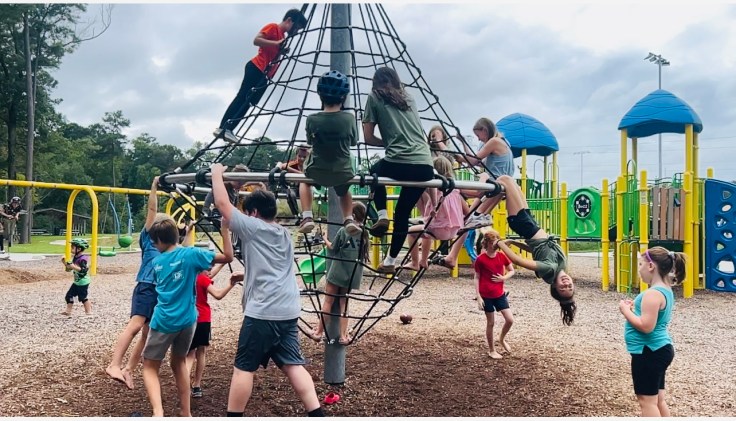
Thinking back to my childhood, I remember long days spent playing outside with friends, engaging in imaginative and unstructured play. We would build forts and secret bases, have epic wars, and create our own games and rules. We’d get hurt and fix each other up so our parents didn’t find out. We convinced ourselves that our neighbor was a kidnapper and created a plan for how we were going to take him out when he finally tried to abduct us. It was a time of pure creativity and freedom. We relied on our imaginations and resourcefulness to entertain ourselves, resulting in a deep sense of independence, self-sufficiency, and resilience.
This unstructured play fostered creativity and problem-solving while teaching valuable teamwork, communication, and conflict-resolution skills. We learned to navigate social dynamics, negotiate with our peers, take risks, and overcome adversity, all essential skills. We knew what was and wasn’t socially acceptable. If we faced a problem, the thought of running to our parents never crossed our minds. We were strong and competitive, but knew when to care for our friends.
As a society, we have become overly cautious and risk-averse when allowing our children the freedom to explore and play unsupervised. We have created playgrounds that are carefully designed to minimize any potential danger. We have stopped relying on older children to be responsible for younger children, robbing younger children of the opportunity to learn from their older peers and robbing older children of the opportunity to develop responsibility. We swoop in to save our children at first sight of someone being unkind to them instead of allowing them to learn to stand up and speak up for themselves.
We have created a generation of young adults who are anxious and depressed, and I believe it is because of a few things. First, I don’t think children have enough unstructured time to develop necessary social skills. And second, I don’t think they feel a strong sense of purpose and responsibility.
There is a ton of research out there highlighting the benefits of unstructured play. But what can parents and educators do to ensure our children benefit from unstructured play? Here are a few ideas:
Remove Distractions
Remove distractions like TV, video games, and other forms of technology that aren’t benefitting your child in some way. If your child is used to being entertained with a screen, adjusting will take some time. Be patient and try not to step in and entertain.
Let Them Get Bored
Boredom will lead to creative ways to learn and have fun! It will also force them to figure out what they are interested in and spend more time on their passions, leading them to grow up knowing what they want and what they are good at.
Limit Toys
Try to limit toys and instead opt for more open-ended materials like Legos, art supplies, cardboard, and lots of tape (any kind).
Resist Over-Scheduling
The more we fill their day with structured activities, the less likely they are to engage in imaginative, unstructured play. We all want our children to develop critical thinking, and the easiest way to teach them that is to not think for them.
Send Them Outside
Send them outside to play. If there aren’t any kids, invite some of your child’s friends over and send them outside. Parks are way underrated. Plan a day at the park where you sit with a book and leave it up to your children to make friends and dive into a world of creativity.
Embrace Risk-Taking
And finally, embrace the risk-taking, knowing that your child will be healthier, stronger (both mentally and physically), and happier for it.
Check out the Let Grow movement for more ideas on how to foster independence in your child!
 LEARNER DRIVEN
Leave a comment